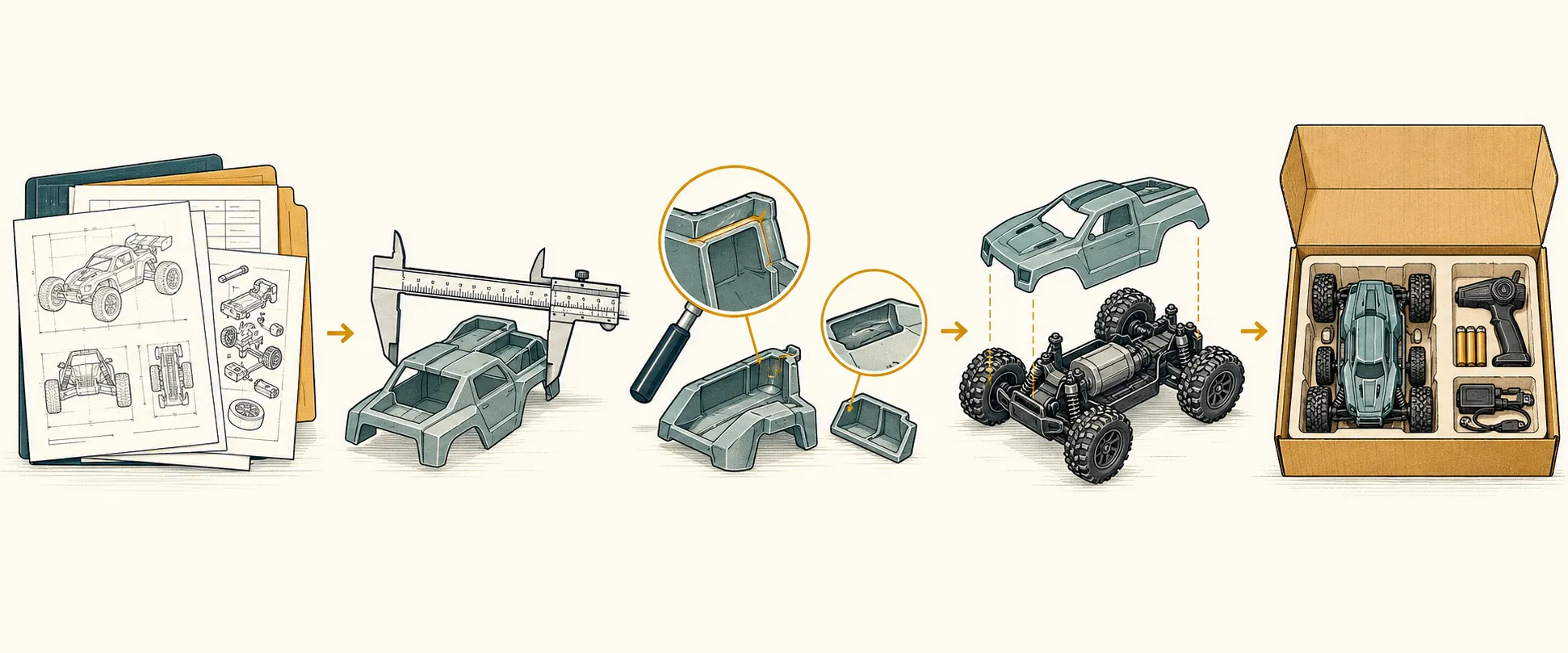
Accept an RC private-label file handover only when the delivered files match the approved project revision, their approval evidence is traceable, and their reuse permissions cover the buyer’s intended next use. Build two linked records: a final-version archive index and a reuse permission register. Then sign a closure record identifying the accepted revision, decision, date, and any open conditions. A folder marked “final” is not enough; the buyer needs to establish which files are approved and what uses are authorized.
This handover method organizes RC car product documents for importers at project completion. It does not replace goods inspection, product safety assessment, or a review of applicable market requirements.
Which version should the buyer accept as final?
Treat a file as final only when its identity and revision match a recorded approval against the agreed specification or approved sample.
Start with the agreed deliverables list and specification revision, not the supplier’s latest download link. For each deliverable, connect the actual file to the approval record: approver, approval date, approved revision, and any conditions. An email approving a packaging PDF does not establish approval of an editable artwork file that was changed afterward.
Separate approved files from drafts and superseded versions. Preserve earlier approvals and change history, but keep them outside the released-file set. If a later edit exists, determine whether it was approved, rejected, or withdrawn; do not select it merely because its timestamp is newer.
Record the production lot or configuration associated with inspection and test documents. A type-test or golden-sample report does not automatically establish coverage of a later lot. Check the report’s model identification, materials, colors, and sample or production cohort against the order. Coverage follows the tested construction and applicable rules—not simply the date printed on the report.
What should the final-version archive index contain?
| Project and product identity | Record the project, purchase order, buyer model or SKU, supplier model cross-reference, destination or language variant, and agreed specification revision. |
|---|---|
| File identity and location | Enter the archive item ID, exact filename, revision, issue date, format, and buyer-controlled storage location. Record a checksum where useful to identify the delivered copy. |
| Agreed deliverable and target | State the required content and format, including editable source files where agreed. For RC instructions, identify the approved vehicle, transmitter, battery, and charging configuration addressed by the document. |
| Observed delivery | Record what was actually received and checked: revision, readable content, working linked assets, and whether the file opens or exports as agreed. Keep these observations separate from the target. |
| Approval evidence | Link the approval record, named approver, approval date, approved sample ID where relevant, and the specification revision against which approval was given. |
| Physical reference | Where acceptance relies on a physical sample, identify the approved master, its custodian, storage location, and the agreed comparison procedure. |
| Document applicability | For reports and inspection records, identify the covered model, construction or configuration, sample or lot, and relevant revision. Record the scope actually supported by the document. |
| Release status and permissions link | Assign an explicit status such as approved for release, superseded, or pending approval. Link the corresponding reuse permission register entry. |
| Exception and closure evidence | Record any mismatch, its owner, required correction, due date, and subsequent verification evidence with reviewer and closure date. |
What should the reuse permission register record?
| File or file-group reference | Link the archive item IDs and exact revisions covered. Avoid a blanket entry such as “all project files” unless the written permission clearly defines that scope. |
|---|---|
| Grantor and supporting record | Name the party granting permission and link the agreement, license, or written authorization. Identify any third-party assets that require separate confirmation. |
| Authorized recipient | Identify the buyer entity and any affiliates, printers, agencies, or manufacturers expressly allowed to receive or use the files. |
| Permitted activities | Record permission separately for archiving, same-supplier reorders, packaging reprints, marketing use, translation, editing, and production with another factory. |
| Product and market scope | Specify the covered models, brands, packaging variants, territories, and sales channels where the permission makes those distinctions. |
| Duration and end conditions | Enter the effective date, expiry or continuing term, and any termination or renewal conditions stated in the permission. |
| Sharing and sublicensing | Record whether third-party use or sublicensing is authorized, by whom, and under what restrictions. Do not treat permission to share for printing as permission for unrestricted redistribution. |
| Dependencies and restrictions | List approval-before-change requirements, attribution, confidentiality, and restrictions affecting photographs, illustrations, fonts, or other licensed assets. |
| Confirmation and follow-up | Record the permission status, buyer reviewer, review date, and any unresolved request with an owner, due date, and evidence required to close it. |
Which post-approval changes should hold up closure?
Hold closure when a post-approval change leaves an agreed deliverable without matching approval evidence or prevents the buyer’s intended reuse.
Compare the final delivery with the last approved baseline. Check changes to artwork, packaging layout, language, materials, colorants, component suppliers, and the vehicle–transmitter–battery configuration where relevant. Record the affected files and supporting evidence; do not reopen unrelated, unchanged approvals automatically.
For example, a changed transmitter button layout should trigger a comparison with the operating instructions and any packaging image showing the controls. A colorant change should prompt review of the color reference and applicable product evidence. These are purchasing checks, not substitutes for safety testing.
For color-critical work, use a physical approved master and an agreed measurement procedure rather than a monitor image as the acceptance reference. This recommended control is informed by X-Rite plastics guidance; it does not establish a universal color tolerance.
A revision record supports traceability but cannot, by itself, reveal an undisclosed substitution. Preserve other valid evidence, including sample comparisons and inspection records, rather than treating the archive index as proof of the delivered goods.
Worked example: packaging files with different closure outcomes
| Print-ready packaging PDF — accept the file | Archive observation: revision C matches specification revision C and the approved physical packaging sample; the named approver and dated approval are linked. Permission entry: the supplier’s written authorization permits the buyer to reprint this model’s packaging with the same supplier for the US and EU during the agreement term, with no sublicensing. Decision: accept this file for that defined use. |
|---|---|
| Project closure — retain the accepted evidence | Record the PDF as accepted without declaring the entire handover complete. Assign the source-file correction to the supplier’s artwork lead and the permission confirmation to the buyer’s project owner, with agreed due dates. Close the conditions only after the corrected source, approval evidence, and permission confirmation are checked and linked. |
What must the signed closure record say?
| Identity and accepted baseline | Enter the project, order and model references; accepted specification revision; archive index version; and reuse permission register version. |
|---|---|
| Target versus verified delivery | Identify the agreed deliverables and intended reuse, then summarize the checked result. Reference individual exceptions rather than writing “all files received” where conditions remain. |
| Decision | Select accepted, conditionally accepted, or held. State the scope of acceptance and the reason for each condition or hold. |
| Responsible approver and date | Record the buyer-side decision-maker’s name, role, signature or recorded electronic approval, and decision date. Identify the supplier handover contact. |
| Open-condition control | For each condition, enter an issue ID, responsible owner, due date, required closing evidence, and any restriction on use until resolution. |
| Follow-up closure | Record the corrective file or permission reference, verification result, reviewer, and closure date. Preserve the original conditional decision and link the final sign-off. |
| Acceptance boundary | State that this record covers the listed file handover and recorded permissions only; it does not replace separate goods, safety, or market-access decisions. |