Choose milestone payments for RC orders when you can verify the event that releases each payment; choose calendar payments when predictable dates matter more and you accept paying independently of production progress. Before accepting either schedule, verify the trigger, supporting evidence, amount, due date, and treatment of delays or disputes. For an order requiring buyer inspection approval, a fixed payment date is not a substitute for that approval unless the contract expressly makes payment conditional on it.
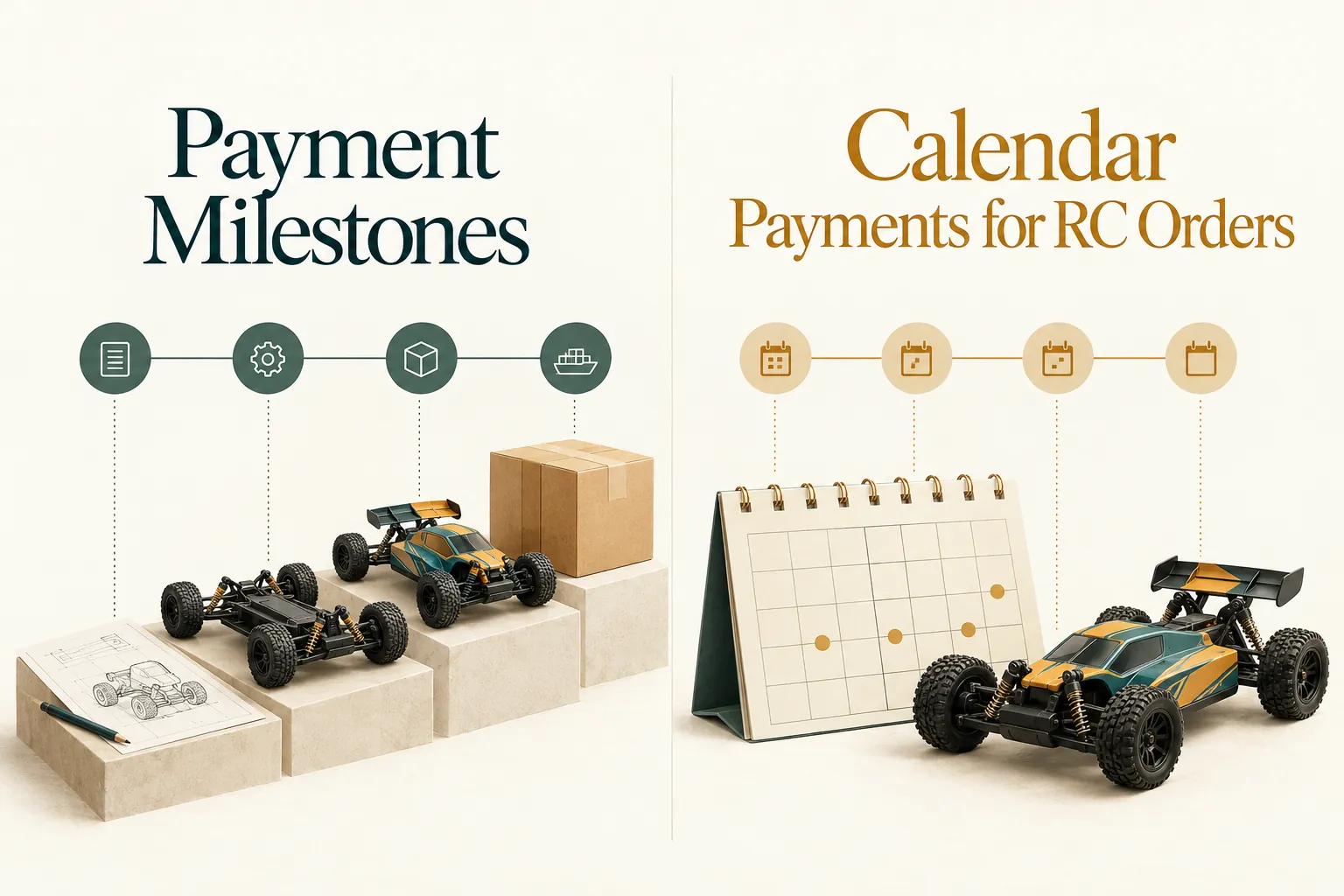
How do milestone and calendar payments compare for an RC order?
| Payment trigger | Milestones: define the accepted event, such as written buyer acceptance of an agreed pre-shipment inspection report. Calendar: specify the date or interval and its starting event. Trade-off: evidence-linked release versus scheduling simplicity. |
|---|---|
| Evidence required | Milestones: identify the exact report, approval, or shipment document that establishes eligibility. Calendar: establish the agreed date, any interval anchor, and invoice requirements; production evidence does not automatically become a payment condition. Trade-off: more progress verification versus fewer event-approval steps. |
| Amount and timing | Milestones: the payment date moves when the qualifying event moves, subject to the agreed terms. Calendar: the payment date remains predictable even if progress slips, unless an exception applies. Compare the unpaid balance and cash committed at the same point in the order—not just the deposit. |
| Delay or disagreement | Milestones: disagreement can center on whether the event is complete or accepted. Calendar: a payment can become due before the buyer considers the goods ready. Each structure needs an agreed treatment of delay, disputed evidence, and rescheduling. |
| Administrative effort | Milestones: someone must collect evidence, check its scope, and approve release. Calendar: finance can plan dates more easily, but purchasing must separately track progress. Choose the administrative burden your team can actually manage. |
| Order length and complexity | Favor milestones for longer or multi-stage orders with accessible approval points. Favor calendar terms for short, fixed-scope orders when timing is stable and payment exposure is acceptable. Duration alone does not make an unverifiable milestone useful. |
Which payment structure fits the buyer’s constraints?
Choose milestones when the order has meaningful approval stages and the buyer can obtain reliable evidence before releasing funds. For example, an RC order requiring sample approval and a later pre-shipment inspection offers distinct commercial checkpoints—but each payment event must identify the relevant order, specification revision, evidence, and approving party.
Calendar payments fit a short, fixed-scope repeat order when treasury needs firm dates and purchasing accepts the resulting cash exposure. Do not select them merely because inspection access is difficult: a date does not resolve that difficulty. Either accept the exposure explicitly or negotiate an event supported by documents you can obtain.
A combination is useful when the supplier needs an initial commitment but the buyer wants the balance tied to accepted evidence. State the basis of each installment separately: an initial payment on an agreed date and a balance after written inspection acceptance are different triggers, not one vague schedule.
Keep the schedule lean. Agiled’s June 25, 2026 guidance cautions that milestone billing adds overhead and can be unnecessary for short or fixed-deliverable service projects. For RC purchasing, the practical lesson is to add a payment checkpoint only when its evidence changes the release decision. Agiled milestone billing
What should a buyer verify in the commercial checkpoint table?
| Order identity and revision | Milestones: Draft M must identify the same RC model, specification revision, and shipment scope as the purchase order. Calendar: apply the same identity check to Draft C. Example evidence: comparison record RC-A, revision A, dated December 2, 2026, references both drafts and the same order specification. Status: Confirmed within the hypothetical record. |
|---|---|
| Trigger definition | Milestones: Draft M says 'balance when ready for shipment'; the buyer requires written acceptance of the agreed pre-shipment inspection report. Calendar: Draft C states December 3, 2026, without a progress condition. Evidence: each draft’s payment clause. Status: Confirmed as draft wording; milestone acceptance definition Unresolved. |
| Evidence supporting release | Milestones: name the report, covered order quantity and specification, acceptance criteria, and written release approval. Calendar: verify the accepted schedule and matching invoice; do not treat a progress report as an unstated payment condition. Example observation: neither draft makes buyer inspection acceptance a balance-release requirement. Status: Unresolved against the buyer’s target. |
| Amount and total reconciliation | Milestones: verify D and B, their currency, and any separately payable charges. Calendar: check the identical items rather than assuming the schedules are financially equivalent. Example evidence: both draft payment schedules state D + B = T in the same currency. Status: Confirmed for the illustrative comparison; no monetary amounts are prescribed. |
| Due date and interval anchor | Milestones: distinguish the qualifying event from when payment must be made after that event. Calendar: identify the exact date, or the starting event for any interval. Example evidence: Draft C states December 3, 2026; Draft M does not explain when payment follows readiness confirmation. Status: Calendar date Confirmed; milestone payment timing Unresolved. |
| Inspection access and approval authority | Milestones: confirm access and name who may accept the report; the report issuer and payment approver need not be the same person. Calendar: retain an inspection plan if required, but state separately whether approval affects payment. Example evidence: the buyer’s planning note expects inspection access, without supplier agreement. Status: Assumed. |
| Late progress, disputed evidence, and grace period | Milestones: agree the treatment of a missed event, rejected evidence, reinspection, and any grace period. Calendar: agree whether the date moves when progress slips and who authorizes the change. Example observation: neither draft addresses these cases. Status: Unresolved; negotiate the exception rather than assuming a right to postpone payment. |
| Choice and conditions | Example decision: select a combination—an agreed initial payment plus a balance conditional on written buyer acceptance of the specified inspection report. Reason: the buyer requires approval before balance release and can manage an event-based payment date. Do not accept Draft M’s undefined readiness wording or Draft C’s unconditional date unchanged. |
| Responsible approver and decision date | Hypothetical record: procurement manager owns trigger and evidence agreement; finance manager authorizes the payment schedule. Review date: December 2, 2026. Decision: conditional selection for negotiation, not authorization to release funds. |
| Follow-up and closure | Procurement obtains a revised, mutually accepted schedule covering the trigger, evidence, timing, approval authority, and exceptions. Finance checks that revision against the invoice before release. Close the record by entering the accepted revision, approver, approval date, and evidence reference; carry any remaining condition into the release decision. |
What does the worked comparison tell the buyer to accept?
Accept the event-linked balance only after its evidence and timing are agreed; the word 'milestone' alone does not meet the buyer’s requirement.
In the hypothetical order, Draft M is closer to the buyer’s objective but still needs revision. Draft C offers a clear date, yet that clarity does not satisfy a requirement for inspection acceptance before balance release. If treasury instead required a firm payment date and the buyer accepted paying before that approval, the calendar alternative would fit that different constraint.
For buyers deciding how to compare RC car supplier quotations, this is the useful comparison: the same amount can carry different exposure because its release conditions differ. A milestone invoice processed on a regular finance payment run remains event-conditioned if the event must be accepted first; the processing date does not erase the condition.
What must be agreed before confirming the RC order?
Agree the payment basis, accepted evidence, amounts, timing, and exceptions in the order documents before treating the schedule as settled.
Use this table as a commercial comparison tool, not as standard RC payment terms or a legal enforceability assessment. The external billing source addresses service projects, and its example percentages are not recommendations for RC orders. Product catalog descriptions establish neither a payment agreement nor approval to release funds.
A signed schedule and evidence record support traceability; they do not guarantee supplier performance or prove that an undisclosed product change has not occurred. Keep the commercial release check distinct from inspection and safety testing, and have the final contract wording reviewed where necessary.